Leave Your Message
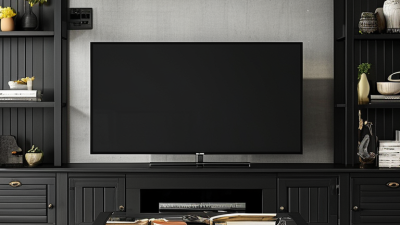
China’s oak furniture sector is gaining attention as buyers seek durable, warm, and space-efficient media furniture. The global home furniture market remains substantial. Grand View Research reported strong market expansion through 2030, supported by urban housing, renovation demand, and online retail. These trends create room for the Oak Tv Stand category, especially in compact apartments and modern living rooms.
China offers more than low-cost production. Established manufacturers combine kiln-dried oak, engineered panels, CNC cutting, water-based finishes, and export quality control. CSIL industry research continues to identify China as a leading global furniture producer and exporter. However, broad furniture reports rarely isolate oak TV stands. That limitation matters. Supplier comparisons should examine moisture content, board construction, load testing, hardware quality, packaging, and documented factory experience.
Frank Lloyd Wright, a respected architect and wood-design authority, wrote, “Wood is universally beautiful to man. It is the most humanly intimate of all materials.” His observation explains oak’s lasting appeal, but appearance alone is not enough. A reliable Oak Tv Stand should support heavy screens, manage cables cleanly, resist surface wear, and remain stable on uneven floors. Small details reveal competence. Check drawer alignment, rear ventilation, edge sealing, and carton protection.
This guide reviews China’s top oak TV stand manufacturers and suppliers through a practical E-E-A-T lens. It considers product experience, technical capability, supplier credibility, and evidence behind quality claims. Some listings may look impressive online. They may still require careful verification. That is the uncomfortable part. Furniture sourcing is rarely perfect, and transparent questions often matter more than polished photographs.
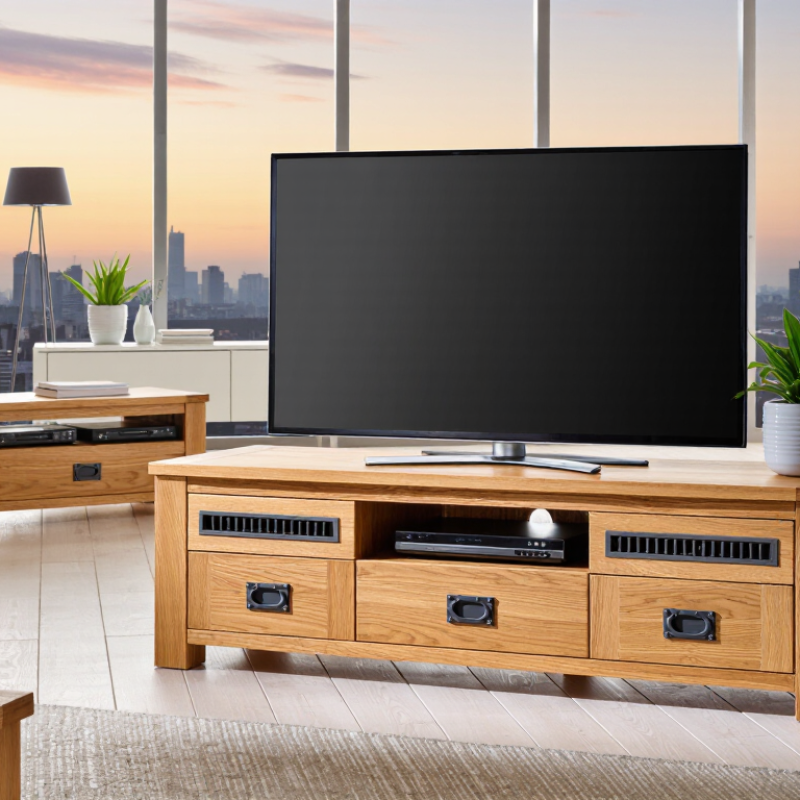
China’s oak TV stand industry combines domestic woodworking capacity with strong export infrastructure. CSIL’s World Furniture Outlook 2024 estimates that China produced about 39% of global furniture output in 2023. This scale supports flexible production, component sourcing, and competitive shipping. Demand is real.
Oak stands usually begin with moisture-controlled boards, solid-wood edging, or oak veneer over engineered panels. Responsible factories record timber origin, moisture readings, adhesive specifications, and load-test results. These records help buyers evaluate consistency rather than rely on showroom appearance. Grand View Research valued the global home furniture market at approximately US$688.7 billion in 2023, with continued growth expected through 2030. That expansion encourages Chinese suppliers to improve finish quality and packaging protection.
Manufacturing details reveal the practical difference. CNC cutting can keep shelf gaps even, while concealed cable openings improve daily use. A durable water-based coating reduces odor and supports easier cleaning. Export-oriented workshops also test carton compression, corner protection, and assembly instructions. However, quality control is uneven. Some smaller factories still depend heavily on manual inspection, which can miss veneer bubbles or slight door misalignment. Buyers should request recent inspection records, sample approval, and independent pre-shipment checks. The weakest point may be documentation, not craftsmanship. Specifications should state oak grade, panel construction, dimensions, hardware, packaging method, and allowable tolerances. That clarity makes supplier comparisons more reliable.
| Industry Dimension | Typical Industry Data | Manufacturing and Sourcing Relevance |
|---|---|---|
| Primary Oak Material | European oak, American white oak, red oak, and oak-veneered engineered panels | Solid oak is commonly used for legs, frames, doors, and trim, while oak veneer over MDF or plywood is widely used for large, dimensionally stable panels. |
| Common TV Stand Widths | Approximately 1,200–2,400 mm | Typical sizes include 1,500 mm, 1,800 mm, 2,000 mm, and 2,200 mm. Final dimensions are generally adjusted to match television size, room layout, and shipping-carton limits. |
| Common Product Depth | Approximately 350–500 mm | This range provides space for media devices, cable management, ventilation, and storage without excessive floor projection. |
| Typical Product Height | Approximately 400–650 mm | Low-profile designs are common in contemporary interiors. Height is normally determined by viewing position, storage configuration, and leg or plinth design. |
| Wood Moisture Content | Commonly controlled around 6%–12%, depending on destination climate | Moisture control helps reduce warping, cracking, joint movement, and finish defects. The target should be agreed according to the importing market and indoor-use conditions. |
| Panel Construction | Solid wood, oak veneer on MDF, oak veneer on plywood, and mixed-material construction | Engineered-core panels improve dimensional stability and material efficiency, while solid oak is typically reserved for visible edges, supports, doors, and decorative components. |
| Surface Finishes | Water-based lacquer, polyurethane coating, oil, wax, and matte or open-pore finishes | Finish selection affects color consistency, stain resistance, tactile feel, repairability, and compliance with customer chemical-emission requirements. |
| Popular Design Styles | Modern, Scandinavian, Japandi, farmhouse, mid-century, and minimalist | Design differentiation usually comes from oak grain visibility, edge profiles, tapered or metal legs, sliding doors, fluted fronts, and cable-management solutions. |
| Storage Configuration | Open shelving, drawers, hinged doors, sliding doors, and adjustable internal shelves | Configuration is selected according to ventilation needs, equipment dimensions, dust protection, and the required balance between display and concealed storage. |
| Cable Management | Rear cable holes, cable channels, removable back panels, and ventilation openings | Cable routing should be positioned according to the customer’s equipment layout while maintaining adequate airflow around amplifiers, game consoles, and media players. |
| Load-Capacity Planning | Common design targets are approximately 30–80 kg for the top surface, subject to construction and testing | Actual capacity depends on span, panel thickness, support spacing, joinery, center supports, and anti-tip provisions. A tested load rating should be specified rather than relying only on material type. |
| Joinery and Hardware | Cam fittings, dowels, screws, mortise-and-tenon joints, concealed hinges, and metal drawer runners | Hardware selection affects assembly time, repeatability, serviceability, perceived quality, and the product’s ability to withstand repeated door and drawer use. |
| Manufacturing Regions in China | Furniture production is concentrated in coastal manufacturing provinces, including Guangdong, Zhejiang, Jiangsu, and Fujian | These areas provide established furniture supply chains, woodworking labor, finishing facilities, hardware sourcing, packaging capability, and access to export logistics. |
| Quality-Control Checkpoints | Incoming material inspection, moisture testing, dimensional checks, finish inspection, assembly testing, and carton inspection | A documented inspection plan helps control oak color variation, veneer matching, surface defects, joint alignment, hardware operation, and packaging damage. |
| Formaldehyde Emission Requirements | Panel products may be specified to E1 or equivalent emission classifications, depending on the destination market | Buyers should identify the applicable national or regional requirement and request laboratory test documentation for MDF, particleboard, plywood, adhesives, and finished products. |
| Packaging Methods | Flat-pack cartons, partially assembled cartons, or fully assembled protective packaging | Packaging commonly combines corrugated cartons, foam or molded protection, corner guards, protective film, and edge reinforcement. The chosen format affects freight cost and damage risk. |
| Export Documentation | Commercial invoice, packing list, bill of lading, purchase documentation, and applicable test or material declarations | Documentation requirements vary by destination, product construction, packaging materials, customs classification, and whether regulated wood or composite panels are used. |
| Sustainability Considerations | Legal timber sourcing, certified wood options, low-emission panels, water-based coatings, and recyclable packaging | Sustainability claims should be supported by chain-of-custody documents, material declarations, test reports, and verifiable packaging or coating specifications. |
Note: The dimensions, material selections, capacity ranges, and production practices shown above are typical industry reference values. Final specifications should be confirmed through approved drawings, samples, technical files, and destination-market compliance requirements.